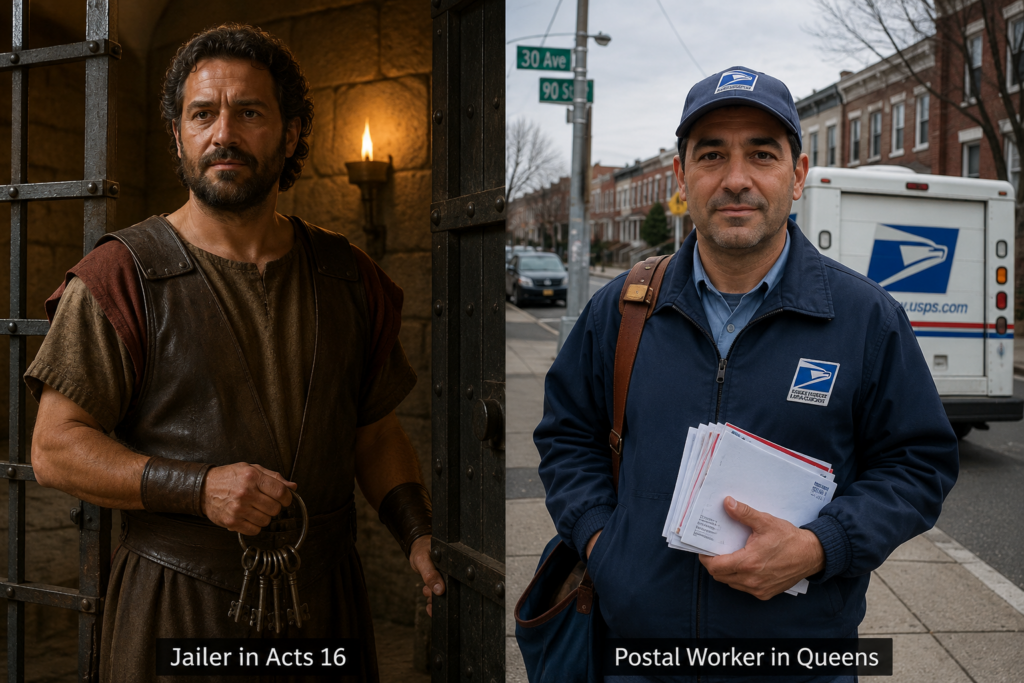
The Philippian church was made up of a great cross section of society. There is Lydia, at the high end of society, sophisticated and wealthy. There is the slave girl, at the lowest end of society and demon possessed. Finally, a guy, a jailer with a family, in the middle class with a good steady job. Keller compares him to a blue collar postal worker living in Queens. He isn’t seeking God at all — not to be won by an intellectual argument or a spiritual experience. He’s content with the honest honor of a good job. How do you reach someone who doesn’t seem to give a rip? See what Keller says — I suggest listening and reading simultaneously for the biggest impact. I think he begins with the jailer about 2/3 through. Slow down, look carefully, and ask for the King to kiss you with His Word!
Father, please kiss us with the kisses of your mouth, giving each of us exactly what You know we need. In Your Son’s name I pray.
https://gospelinlife.com/sermon/a-woman-a-slave-and-a-gentile/ \
Sunday:
- How has the Lord helped you to experience His love, grow from His Word or His discipline, or guide you in a tough situation?
Monday: The Text
2. Read Acts 16:25-34 and make an observation on each verse, not so much telling what happened, but your thoughts about what happened.
3. What stood out to you the most and why?
Tuesday: Keller Part I. An Inextinguishable Joy
Now last of all, we have a third guy. We have a guy finally. We got to a guy, guys. We have a man. In other words, everyone in here (even men) is able to be saved. Only one, but even men. Let’s do a profile on the jailer. He is almost certainly a former Roman soldier. Why? Because all civil service jobs were given to retired Roman soldiers. It was just a given because they were good jobs.
Besides the fact that we see his life is neither a success nor a mess (he is not the success of Lydia; he is not the mess of the poor slave girl), we can almost be sure he would not have needed or wanted a long intellectual discourse, nor would he have wanted or needed a deep, emotional encounter. He is an ex-GI, blue collar, regular guy. You can sort of get a hint of why he would neither expect nor want a deep, emotional experience or a rational kind of argument by looking at how he responds when he thinks the prisoners are gone.
In those days … Well, I’ll get to that in a second, but the point is he draws his sword. Why? What matters to him? He is a soldier. What matters to him is not sentiment. It’s honor. He lost the prisoners. He is going to fall on his own sword. I mean, there you go. This is a person who is a practical man, you might say. He is not an emotional person, not a rational person. You might say he is a practical man and someone who, by the way, is spiritually indifferent.
Of all these three cases, he is the one who is not seeking at all. Not in the slightest. He has no spiritual interest at all. You know, if Lydia lives on the Upper East Side and the slave girl works under one of the East River bridges, this a guy who lives in Queens. He works for the post office. He is fine. He is not spiritually seeking. No, he is not a worshiper of God, nor he is spiritually in turmoil. He is not really a very good person or a very bad person. He is just a regular guy, spiritually indifferent.
Notice (this is very important to notice) Paul brings the gospel to Lydia. Paul brings the power of the gospel to the slave girl, but he doesn’t do it to this guy. This guy has to come to Paul. Why? Because you don’t tell the gospel to somebody who doesn’t give a rip. You show the gospel to somebody who doesn’t give a rip. This man was the jailer, and he receives these two prisoners. They’re all beaten up. They’d been beaten by rods, which means they would have been oozing. They would have been dripping with blood.
Notice at the end, by the way, he binds up their wounds, which is what he should have done when they first got there. They weren’t just normal prisoners. They’d been beaten within an inch of their lives. What he does is he puts them in the stocks, which is a form of mild torture, because your legs were pulled way apart to get your ankles into these two holes that were pretty far away. He shows no concern for them. He is absolutely callous. How do they respond to him?
Two things happened that he has never seen before in his life, and they completely change him. The main thing actually (there are only two aspects to it) is their attitude toward suffering. The first thing he sees is verse 25. “About midnight Paul and Silas were praying and singing hymns to God, and the other prisoners were listening to them.” They’re praising God in the midst of their suffering!
In other words, they had a joy that was rooted in something so deep that when you took their money away, you took their freedom away, you took their comfort away, and you looked like you might be about to take their life away, the joy was still there. Their joy was rooted in something so deep that you could take almost anything away, and the joy was still there. That’s weird.
4. What does Keller say is the first thing that must have seemed weird to the jailer?
5. Why do you think Paul and Silas were praying and singing?
6. A few weeks ago our own Cheryl says people ask her how she got through the great sorrow in her life. She obviously showed them her faith, which intrigued them. J. B. Phillips paraphrases 2 Corinthians 6:10 as “We know sorrow, yet our joy is inextinguishable.” Have you experienced that? If so, can you explain why you still had joy with your sorrow? Be specific.
Wednesday: Keller Part II. A Different Story for Suffering
Then the second thing the jailer had never seen besides that kind of joy was there was an earthquake. Of course because there was an earthquake, the jailer sees the doors are opened. In that time, in that day, the law was if you were a guard and you were guarding a prisoner and the prisoner escaped, the guard was executed. If you were a jailer and any of the prisoners escaped, the jailer was executed.
The reason he was about to kill himself was actually because it would have been a public humiliation. He would have been executed anyway, so this was his way of, in a sense, saving himself that humiliation. Paul and Silas knew once the doors were open they could escape. After all, they didn’t deserve to be there, right? They also knew if they escaped, they escaped at the cost of the jailer’s life.
They knew all the other prisoners, if they escaped, they would only escape and get their freedom at the cost of the jailer’s life. Guess what? They kept them in there. They repaid evil with good. They knew all they had to do was let even one guy leave, and the jailer would be gone. After what the jailer did to them (get this), they repaid evil with good. The jailer had never seen anything like that.
Now we know at the very center of Paul and Silas’s personality was a whole new pattern. What is the pattern? The ultimate example of repaying evil for good was Jesus Christ dying on the cross, Jesus Christ praying for forgiveness for the people who were killing him. To put it another way, the reason they would not get their freedom at the expense of the jailer’s life was because they had already gotten their freedom at the expense of Jesus’ life.
They now were people who overcame evil with good. When the jailer saw that, this practical man … An argument wouldn’t have worked. An emotional encounter wouldn’t have worked. This practical man gets on his knees and says, “You have something I don’t have. I want it.” What actually he was saying was that a story had come into Paul and Silas’s lives that enabled them to handle suffering and to handle abuse in a way he never could.
A story had come into their lives. A narrative structure had now created a new narrative world, and it changed their character. So whereas Lydia got words of rational discourse and the slave girl got a power encounter, this guy gets an embodiment of utterly changed character. He gets a glimpse of a new narrative world. That means a world, a character, a heart that’s utterly changed. People who live in a world that has been very changed because there is a new story that overarches their life, and it’s changed the way in which they handle abuse and suffering.
Let me give you an example of it. William Willimon is a pastor, but he also is the chaplain now at Duke University. He is a very prominent faculty member there, but he is a minister. He tells this story from early in his ministry. He says, “Early in my ministry, I arrived at a hospital room where a woman in my church had just given birth. I had been told that ‘there were problems with the birth.’
A couple sat in the hospital room waiting for the doctor. The doctor appeared shortly after I arrived and said to the new parents, ‘You have a new baby boy. But there are some problems. Your child has been born with Down Syndrome. Your baby also has a rather minor and correctible respiratory condition. My recommendation is for you to consider just letting nature take its course, and then in a few days there shouldn’t be a problem.’
The couple seemed confused by what the doctor had told them. ‘If the condition can be corrected, then we want it corrected,’ said the husband. His wife immediately nodded in agreement. ‘You must understand that studies show that parents who keep these children have a high incidence of marital distress and separation. Is it fair for you to bring this sort of suffering upon your other two children?’ said the doctor.
At the mention of the word ‘suffering,’ it was as if the doctor finally began speaking the woman’s language. She said, ‘Our children have had every advantage in the world. They have really never known suffering, never had the opportunity to know it. I don’t know if God’s hand is in this or not, but I could certainly see why it would make sense for a child like this to be born into a family like ours. Our children will do just fine. When you think about it, this is really a great opportunity.’
The doctor looked confused. He abruptly departed, with me following him out into the hall. ‘Reverend, I hope that you can talk some reason into them,’ said the doctor.” Willimon finishes this way. “The couple was already using reason, but it was reasoning that was foreign to that of the doctor. For me, it was a vivid depiction of the way in which the church, at its best, is in the business of teaching a different language from that of the world.
The church, through its stories … teaches a different language whereby words like ‘suffering,’ words that are unredeemably negative in our society, change their substance. Here was a couple that had listened to a peculiar story, namely the life and death of Jesus Christ, in which suffering could be reasonably redemptive.”
That’s what the jailer saw, and he didn’t understand it. He said, “I want that story in my life. I want to be able to handle suffering. I want to be able to handle abuse like that. I’ve never seen people with such integrity. Why didn’t you get your freedom at the expense of my death?” The answer is, “We already have our freedom at the expense of another one’s death who gave his life voluntarily. Let me tell you about him.” His life was changed.
7. Why does Keller say the jailer wanted to kill himself?
8. How does Keller explain why the jailer came to Christ?
9. Can you relate to the jailer’s experience? Has a Christian’s positive response to suffering impacted you? If so, explain.
10. Why was the doctor mystified by the couples’ response to their baby born with Down’s Syndrome?
Thursday: Keller Part III. No Religious “Type”
Conclusion. What do we learn from these three cases? There are three things kind of quickly. First, the gospel is for everyone. Let me put it negatively. There is no religious type. If you are a person sitting in this room saying, “Well, I’m just not the born-again type. I’m not the religious type,” as you can see, the gospel is for religious types but not only for religious types. Religious types really need it badly because they’re kind of screwed up.
What Luke is trying to say is there is no type of person who the gospel is more natural to. For example, there’s no racial type. You know these are three different races, at least. Lydia was from Thyatira. She was probably Middle Eastern. To our eyes, she would have looked Middle Eastern or Indian. The slave girl could have been anybody, because she was a slave. She could have been from anywhere. The jailer was a Roman. He would have been European.
Here we have all the different races. Christianity is the only religion, friends (listen carefully), that has never been dominated by one part of the world. Islam’s demographic and geographic center has always been the Middle East and Arabia. Hinduism’s demographic and geographic center has always been India. Confucianism … China. Buddhism … Asia. Christianity started as a Middle Eastern religion. That was its center. Jerusalem … the Jews.
Then it migrated, and its demographic and geographic center was the Mediterranean Hellenistic world. Then it migrated to Northern Europe as the center of it. Then North America. Now as we know, I hope, there are more African Christians, there are more Latin American and Asian Christians, Korean and Chinese Christians, for example, then there are in all of Western Europe and North America put together, even if you count the people who just say they’re Christians, even the ones who are just nominal Christians. Why?
Because Christianity is one religion there is no type. There is no culture it’s native to. There is no type of person. There is no personality. It’s not for the rich. It’s not for the poor. It’s not for men. It’s not for women. It’s not for wimps. It’s not for the ambitious. It’s not for the moral types. It’s not for the immoral types. Because it’s not based on any one human factor, it mustn’t be based on a human factor.
That means, on the one hand, if there’s anybody here saying, “I’m just not that type. I’m not the Christian type,” you may not get out from under your responsibility to consider this like that. If you are a Christian who looks at anyone else around you in your family, in your neighborhood, or anyone else around you and says, “That kind of person would never become a Christian …”
Oh, and you are. So you’re wonderful raw material. We’re so happy you’re with us. If you lose hope for anybody or if you show contempt for anybody, you don’t really know you’re a sinner saved by grace. You’re more religious than you are a Christian. The gospel is for everybody.
Secondly, there is no greater unifying factor on the face of the earth than this. I’m not saying Christians have made use of this like they should. I’m not saying there hasn’t been segregation. I’m not saying there haven’t been all kinds of tragedies. Let me show you what the gospel can do if we draw on it.
We know this about Paul. There is an ancient prayer Jewish men prayed in the morning. It’s a very controversial prayer. You can go on the websites and see all the different debates about it. I’m not here to defend it or criticize it either, but we do know Paul would have used it. It’s a very famous prayer Jewish men often prayed first thing in the morning.
“Oh Lord God, I thank thee that you did not make me …” What? “… a woman, a slave, or a Gentile,” which means, here is Paul who, as a Pharisee, would have gotten up for days and days and years and years every morning, saying, “Oh Lord, I’m so grateful I’m not like those women. I’m not like those slaves. I’m not like those Gentiles.” The first three conversions of his new church in Philippi are a woman, a slave, and a Gentile. Now they’re his family. What changed Paul? What power could bring people like that together?
I am not in any way trying to mitigate all the ways in which Christians have failed to draw on the power of the gospel to unify people across these cultural barriers, but I’ll tell you this. As bad as we are, if you’ve been a Christian for even five years, you have several really close friends already, because of Christ, across barriers that if you weren’t Christians, you would never have known that person. You would never have wanted to know that person. You wouldn’t have even given them the time of day, and you know it.
Anybody I know practically who has been a Christian for even five years, there are some people who have come into your life or your brother or sister. If it wasn’t for Christ, you wouldn’t even have anything to do with a person like that because apart from Christ, you disdain somebody. If your identity is based on being liberal, you don’t want to know conservatives and vice versa. If your identity is based on your ethnic pride, you don’t want to know the other ethnic groups, especially not the ones that have been mean to you.
You know, if your identity is based on your class or whatever … If your identity is based on Christ, you don’t disdain anybody because you’re a sinner saved by grace. There is no more powerful unifying factor I know in the world than the gospel. The gospel is for everybody. The gospel is a unifying factor. One more thing.
The gospel can’t be canned. What I mean by that is … I’m not saying you can’t take a summary of the gospel and learn it and use it with people. That’s fine, but I’m talking about the approach. Look at these three approaches. They’re utterly different. I’m reminded of Jesus. Jesus moves into … Remember John 11? He goes to the funeral of Lazarus. The first woman who comes up is Martha. She says, “Lord … if you had been here, my brother wouldn’t have died.”
Jesus says, “Resurrection.” “Yes, I know the resurrection.” “I am the resurrection,” he says. Then he moves to Mary. Mary comes up and says, “Lord, if you had been here, my brother wouldn’t have died.” Jesus just weeps. Now wait a minute here. Two sisters, same situation. Their brother has died. Same situation. Same funeral. Same words. They both come up to him and say the same words.
Jesus’ response to them is utterly dif
different. Why? He is smart. He knows what they need. Listen. He challenges you, and he adapts to you. He challenges your condition, and he adapts to your condition. If he only adapted to your condition, you’d never be changed. We need people to tell us the truth. If he only challenges you and doesn’t adapt to your condition, you would turn him off. You wouldn’t hear him.
Jesus is always the one who perfectly challenges you and adapts to you. He knows just how much to challenge, just how much to adapt. He knows just what you need. He knows the process. Let’s be like him in the way in which we talk to people. Jesus was powerful enough for the slave girl. He was beautiful enough for Lydia. He was practical enough for the jailer. He is whatever you need. He’ll challenge you, but he’ll be whatever you need. Go to him. Let’s pray.
Thank you, Father, for these three case studies. Help us to unlock in our own lives the power of the things we see there. We pray you would enable us to hear the gospel in the depths of our being like the slave girl did. We pray you would help us to understand the gospel and have it transform our thinking like Lydia did.
We pray you would help us to embody the gospel in our lives so we can have that utter change in character that the jailer saw. We ask you would help us to realize these things in our own lives and, through us, others would realize it too. We pray this in Jesus’ name, amen.
11. How does Keller make his case that there is no religious type from the account of a woman, a slave, and a Gentile?
12. Who is the last person that the Lord allowed you to partner with Him in winning to Christ? How do you think He reached their hearts?
13. Is your church a cross-section of society? (So many of the churches in my area have nearly all “country club types,” and they also don’t preach the gospel.)
13. What else stood out to you from Keller’s message?
Friday: Tara-Leigh Cobble’s Thoughts
14. Watch Tara and share what stands out and why. 10 minutes.
Saturday:
15. What’s your “God Shot” and why?
96 comments
Sunday:
How has the Lord helped you to experience His love, grow from His Word or His discipline, or guide you in a tough situation?
Today, we had a speaker on YouTube from New Mexico give the first part of a 2-part message on the “Ministry of Forgiveness”. I thought of your home church right away, Dee! I wondered how you and your leadership team choose “visiting” speakers? I know you mentioned having Keller speak at times. We are still praying for a teaching pastor for our church; our pastor has been listening to this guy from NM for a few years now and thought we might want to consider listening to him. In this particular message, he mentioned the Puritans as well as Michael Reeves!
Although we were in Colossians 4, Pastor Joshua Valdez said something about the church in Colossae being a cross-section of society as well (Onesimus, a runaway slave, Philemon, etc).
From last week’s study, I was prompted to reach out to two friends who are involved in the Crisis Pregnancy Center in the city where we used to live. I asked one of them, who is the manager, if there was anything I could help with. She gave me a list of things to pray for and consider. And as a kiss from the King (I mentioned you, Dee, as leading us on a topic of biblical justice), she said that one of her favorite Bible Studies she has done in the past was Dee’s “Falling in Love with Jesus”! She called it “an oldie, but a goodie!”
Bing — this is a fun e-mail. And prayer is one of your gifts — so that was a great pairing.
We all listen to a sermon ahead of time and our steering committee chooses them, but it’s really me as they have balked at so much listening. We do mostly Keller but also Alistair, Reeves, and sometimes Paige. We did a few famous sermons but some were quite upset by them for they were so stern — yet the reason they are famous is that they dramatically impacted lives. John Piper’s Seashell sermon was one — and one couple was so upset I had to visit them twice — and then the next week we did Paige and because we cannot listen ahead of time I didn’t know she was going to praise John Piper’s Seashell sermon. Oh my. I guess that was God’s sense of humor.
You are such a blessing to so many, Bing. I also wondered how you selected your sermons, Dee. Prayer is so powerful! And what a sweet Kiss from the King, with Dee’s “Falling in Love with Jesus” study. Your studies have impacted so many lives, Dee! God is so good!
Sunday:
How has the Lord helped you to experience His love, grow from His Word or His discipline, or guide you in a tough situation?
Good day friends…I missed out on so much last week but did enjoy reading all the comments and learning from all of you. I love that the Lord made each one of us unique and has given us each our own story and need to hear the gospel just as he planned. I’m holding onto scripture from Romans 15:13 this week which says, “May the God of hope fill you with all joy and peace as you trust in him, so that you may overflow with hope by the power of the Holy Spirit.” We each need hope in our journey here on earth. I’m hoping in God and his power to prevail over unbelief, sickness and pain in this world.
In addition to this great verse in my life this week, I found a little word of advice from Marcus Warner in his book, “What Every Believer Should Know About Spiritual Warfare.” I am looking at a wholistic medical clinic run by a medical doctor from India to help answer medical concerns which my traditional doctor has not been able to, along with the natural alternatives I’ve tried. She is Buddhist and I’m a bit nervous about the spiritual side of things. She says she uses evidence based practices, but I haven’t met her yet or know whether she uses any Eastern practices which could open a door to the enemy. The book offers a prayer to say if in doubt to bind the enemy. I appreciate this as it is not always clear and the enemy parades as an angel of light. I now feel more at ease about looking into her practice as she seems to specialize in the area I need and has a great deal of experience.
I’m looking forward to learning about the jailer this week.
Chris, thanks for the verse! Be praying as you meet with this doctor from India. Where I hail from, the Philippines, we have traditional herbal remedies that some of my cousins subscribe to. I have a mature Christian friend there who had some serious form of cancer many years ago that was treated with a specific vegetarian diet. She has survived the cancer by the grace of God. I lost track of her latest health condition but know she is alive and well. It would be interesting to follow up with her to see how her doctor’s practice has continued and whether it is evidence-based.
Thank you for the prayers, Bing. So interesting about your friend.
My concern arises from wanting to make sure I’m not receiving healing that isn’t from the Lord. I read a story in Marcus Warner’s book on spiritual warfare where a man received healing in a crippled leg presumably from a healing service of some kind, but then became depressed. A prayer was said that if the healing of the leg was not from God that it would be removed. Immediately the leg returned to its former state and the depression lifted.
Will pray for you, Chris. God has certainly used unbelievers in the past to give wisdom, for all wisdom is from above and He can even used Balaam’s ass. But good to pray.
Thanks, Dee. You make me laugh about the donkey. I do look at animals differently since learning that story and God can use unbelievers.
I join Bing in praying for you Chris, as you work with this wholistic clinic and the medical doctor from India. It is interesting that she is Buddhist and not Hindu. Maybe Buddhism is also part of the Indian culture too. (?) I do believe that there are good natural options that many regular doctors are not open to using. I will pray that the Lord will give you His discernment, as you learn about these practices. You are blessed to have a farm where you can grow your own produce.
Patti, I shouldn’t assume she is Buddhist or from India, but it looks that way on her website. There are also signs of Hinduism, so maybe both. Her parents immigrated here and are also doctors. I’m sure it will be interesting. I asked my MD’s advice about her and he agrees it would be good to look into. She is an internal medicine doctor with more than 20 years experience but also functional medicine. I appreciate the prayers.
Chris, I just saw the words” functional medicine” on your comment. I have a friend who goes to a chiropractor who does something aligned with this type of medicine. She seems agreeable to his treatment regimen.
i follow this PT guy named Will Harlow on YouTube and reading his book on “ independent living”. I like his approach as he explains the rationale behind exercises he advocates for. His book is specifically targeted to people over 50. Great testimonials and I find him entertaining too and innovative. Exercise snacks is one phrase he uses which I love.
1. How has the Lord helped you to experience His love, grow from His Word or His discipline, or guide you in a tough situation?
I am so grateful for God’s protection for my family and extended family in Spokane, Washington. My granddaughter, Sara, and my daughter’s stepson, Clay and his family, all had to evacuate their homes with no notice, due to high winds causing rapidly moving fires in Spokane, Washington. They are all safe, including their pets. Praising God for His goodness and protection.
Sadly, Clay, his wife and their two teenage children, lost their entire home, and all the personal heirlooms and memories. I don’t know where their family is spiritually, but I pray that they will sense God’s presence during this time. I don’t know them personally, but my daughter, Dawn, has a wonderful relationship with all of them. Sara called me as soon as she was able, because she knew I would be worried. I am so grateful for her. Over 600 homes have been lost, but these things can be replaced. It is by God’s Grace so many have been saved.
Patti, I’m so glad that your family is all safe. Such sadness over the loss, but you are right-such things can be replaced.
That is scary stuff, Patti! Thankful that life was not lost for your family. Praying for their peace and for a place to live.
Wow, Patti! Praise God for their safety and love you are praying for them, though you really don’t know them.
2. Read Acts 16:25-34 and make an observation on each verse, not so much telling what happened, but your thoughts about what happened.
V25: Paul and Silas had such great faith to be singing hymns and Praising God, while in such pain and stress. It must have been so shocking for the prisoners who could hear them. I wonder if it comforted them. It was probably life changing too.
v26: When such a miracle happened, it must have been so shocking to the prisoners…..when their chains fell off and the doors opened…. I wonder if they connected it to Paul and Silas. I have the feeling that Paul and Silas were not surprised!
v27: I imagine the jailer thought he would be blamed and killed if the prisoners had escaped, so he was taking a less painful way out.
v28: Paul wanted the jailer to know he would be covered and no harm would come to him. He must have been so shocked that Paul was repaying the evil he had experienced, with God’s care and comfort for the jailer .
v29: The jailer must have realized that this was a spectacular act of God, and that Paul and Silas were filled with something of God, when he fell at their feet. His heart was changed immediately!
v30: The jailer wanted whatever this gift was that Paul and Silas had, and wanted to know how to get it. He could see they were different than anything he knew. I love how this action of God’s love changed all the events that followed.
v31: What a turn of events for this man’s life and family. They responded verbally, after the jailer asked them. Paul and Silas were so filled with the love of God in their response to their treatment, it changed lives.
v32: The actions of Paul and Silas, came before they spoke. He saw God in them, before He heard the Word of the Lord from them.
v33: Now the jailer showed God’s love in caring for Paul and Silas. This love spread with the jailer’s family; they all believed. I love how many lives were changed by the love of God during a torturous time.
v34: The jailer took such care of them, but they remained prisoners so no harm would come to him. In spite of the circumstances, Paul and Silas showed the Love of God and the outcome was many coming to Jesus.
3. What stood out to you the most and why? God’s love is an action …..it is the Word of God lived out. It is not returning evil for evil, it is reacting with God’s love, even when it is not deserved. They acted, then they spoke. It was not the circumstance that changed the outcome, it was the response that Paul and Silas has that changed the outcome.
Patti, Your comments about the love of God, and the love Paul and Silas showed, have given me another “lens” to use. I’m going to reread the passage right now!
I agree, Patti! Their response is not what is expected in such a situation, but their faith changes everything.
Such a good summary on the love of God, Patti.
Monday: The Text
2. Read Acts 16:25-34 and make an observation on each verse, not so much telling what happened, but your thoughts about what happened.
25: Paul and Silas were still awake at midnight in their cell (feet in stocks, so much pain!) not moaning and groaning, but praying and singing! The other prisoners were listening. The other prisoners were probably astounded, and yet, the prayers/singing drew them towards the Lord.
26: Suddenly an earthquake hits shaking the building, doors open, chains fall off, stocks are released. In other words, God shows up!
27: The jailor wakes up sudennly (probably shaken out of his bed) and runs to check on the jail. All the doors are open! He knows that he is responsible for the prisoners, and thinks surely they must have escaped. The jailor must have been in a panic thinking that all was lost: his job, reputation, position in the community. Better to kill himself than to live in disgrace.
28: Paul yells out, “Don’t do it! We’re all here!” The jailor just supposed the prisoners had escaped; he really did not see them; it was dark. So how did Paul see the jailor, and why didn’t the other prisoners run away when they were free to do so?
29: Only then does the jailor think to ask for some light ( maybe a torch), and what were the other helpers doing at this time anyway? Having heard Paul, the jailor rushes to that cell and enters it trembling. He was in awe of P&S, surely they were under divine protection, and he falls down before them.
30: Yesterday P&S were scurvy prisoners to be handled roughly, and now the jailor treats them with respect calling them “Sirs” and taking them out of that dank cell. The Holy Spirit has convicted the jailor’s heart. He now knows that P&S are sent from the true God, that his actions have been wrong, and what can he do now to be saved?
31: P&S don’t complain about their treatment at the hand of the jailor (asking for an apology) or tell the jailor to repent. They tell him to BELIEVE on the Lord Jesus Christ for salvation. This salvation was even possible for the jailor’s family.
32: P&S preached the gospel message to the jailor and everyone living in his house. Were they all awakened by the earthquake and were awaiting his return from the jail, or did he wake them all up when he brought P&S back to his house? Either way, it was a revival meeting in the wee housrs of the morning!
33: Hallelujah! They all believed! But wait, we need to take care of the wounds on Paul and Silas. Also we want to be baptized right now!
34: Time for breakfast! What a meal that must have been. I can just imagine the conversations and rejoicing happening in that home. An entire household coming to saving faith at the same time!
3. What stood out to you the most and why? God’s intervention and the moving of the Holy Spirit. The total peace and trust that P&S had in that cell trancending any physical pain, the earthquake, the prisoners seemingly spellbound, the conviction/conversion of the jailor, the quickening of his whole family, all point to the majesty and power of God.
I love your thoughts on v. 24 “Time for breakfast!” And we know that sharing a meal with somebody denotes intimacy. It does not matter if you are a prisoner or the jailer.
I agree with you both on the meal! And Wow! The “power and majesty of God” for sure!
Bing — like your comment on how they didn’t mention the mistreatment. Impressive.
I love that about the meal together too, Cheryl. I love that you point out that the Holy Spirit convicted the jailer, and quickened his whole family. God moves on ways we never imagine.
1. How has the Lord helped you to experience His love, grow from His Word or His discipline, or guide you in a tough situation?
I had one more class that I committed to for our women in ministry study. Several people dropped out and I was disappointed and feeling like I had failed. I was going to cancel and then thought, “No, I made a commitment and I’m going to stick to it.” I was so glad I didn’t cancel! I enjoyed talking to the ladies who kept coming with me and I actually continued to learn. I was able to use this study and make an analogy to the societies in Ephesus, Corinth, and Crete. Thank you Lord!
I am glad you did not cancel, Laura. Good to hear you are persevering. My husband often reminds me, “If it helps one person, then your effort is worth it.”
I’m glad you kept true to your commitment, Laura. I love to hear that your fellowship with the women that did come was beneficial. The Lord knew who would be there, and I think you honored Him by continuing to serve.
Laura, you make me wish I could sit in on your class! You are learning so much. I applaud you for sticking to it. Often I have found that a smaller group who is truly interested in the subject will still be a great benefit to teach.
Laura, I so agree with the others. You were so wise to stay with it. I agree, if it even changes one life, that life will change more. I would love to hear you teach.
Monday: The Text
2. Read Acts 16:25-34 and make an observation on each verse, not so much telling what happened, but your thoughts about what happened.
v.25 About midnight Paul and Silas were praying and singing hymns to God, and the other prisoners were listening to them.
“What a fellowship, what a joy divine, leaning on the everlasting arms!” is the hymn that I could imagine them singing (ugly tears here)
v. 26 Suddenly there was such a violent earthquake that the foundations of the prison were shaken. At once all the prison doors flew open, and everyone’s chains came loose.
We have had earthquake tremors in the Philippines when we were there before, and I can just imagine how frightful that might have been for the other prisoners and the jailer.
I wonder how those feet and hands felt when those tight shackles came off. Is this just a dream or something? The ruckus that ensued must have been loud, especially in the dark. Paul and Silas might just have been saying, Hallelujah!
Verse 27: The jailer woke up, and when he saw the prison doors open, he drew his sword and was about to kill himself because he thought the prisoners had escaped.
I can almost hear the sword being taken out of the scabbard by the jailer after he woke up and saw that the prison doors were open.
v.29-30 The jailer called for lights, rushed in and fell trembling before Paul and Silas. He then brought them out and asked, “Sirs, what must I do to be saved?”
Goosebumps here. The other prisoners might be dumbstruck by what just happened
V.31-32 They replied, “Believe in the Lord Jesus, and you will be saved—you and your household.” Then they spoke the word of the Lord to him and to all the others in his house.
Paul addressed the jailer’s needs without them thinking about themselves. Sharing the gospel takes precedence over my own safety and protection.
v. 33-34 At that hour of the night the jailer took them and washed their wounds; then immediately he and all his household were baptized. The jailer brought them into his house and set a meal before them; he was filled with joy because he had come to believe in God—he and his whole household.
It did not matter what time it was. The jailer knew in his heart that he wanted what Paul and Silas had for himself and his household. For certain, he would have heard them singing despite their wounds and pain. I wondered, too, if he saw the earthquake as a precursor to something unusual that was about to happen.
1. What stood out to you the most and why?
I may encounter undeserved suffering, but I can trust Jesus for deliverance. To pray and sing when I am wounded in any way-physically, emotionally, spiritually. I am not good at dealing with suffering, but I have learned in the little that I have experienced compared to others that God is faithful.
Bing, I love you answer about the jailer take P&S to his family in the middle of the night! Great priorities! I love your last answer about undeserved suffering. God is faithful, even when we do not understand.
Monday: The Text
2. Read Acts 16:25-34 and make an observation on each verse, not so much telling what happened, but your thoughts about what happened.
v.25 I can just imagine sitting in this jail with my feet in stocks and freshly beaten, praying out to God and singing hymns to soothe my pain and praise God for his faithfulness in this circumstance, all the while encouraging the other’s listening. V. 26 I cannot imagine the great earthquake opening prison doors and loosening my bonds! Paul on the other hand seems to expect it as an act from God! V. 27 The shock of the jailer! He must of thought his life would be over so he may as well do it himself! V. 28 Paul was moved to great care for the jailer’s life in this frightening moment. V.29 I love that the jailer shows his gratitude to Paul & Silas. V. 30 The jailer now shows respect to his prisoners and seeks their advice on salvation. V. 31 Paul’s answer is so simple. V. 32 Paul did not hesitate to share the gospel with this whole family of unbelievers. V. 33 the jailer shows kindness in washing the wounds and Paul at once acknowledges their faith in baptism. V. 34 as is fitting they all celebrated belief in God with food!
3. What stood out to you the most and why?
Two things: 1. Paul’s seemingly expectant response to the miracle of being released from prison. 2. His desire to save his captor-he took no time to hold onto hard feelings toward this jailer, but immediately wished for him to be saved both physically and spiritually.
Chris, what stood out to you is something I had overlooked, Paul’s concern for the jailor’s life. “His desire to save his captor-he took no time to hold onto hard feelings toward this jailer, but immediately wished for him to be saved both physically and spiritually.” Again, another “lens” to use when looking at this passage,
Amen to Cheryl, Chris.
These weeks with family are golden. I have 3 families here: 14 people and 3 dogs. It is usually messy and that is hard for me, yet I am so glad they are here. I often think of that proverb “Where there are no oxen the crib is clean, but how good is the strength of the ox!” I treasure the quiet mornings on my deck, though they are short before I am joined, yet I am so thankful for the winters are long and very solitary. 2 daughters and a niece and I are headed for my women’s Bible study which has at least 3 unbelievers — it is always exciting. Wild things are said but we live by Alpha’s motto – -don’t correct, just keep them coming back. We are doing encounters with God — today — the end of Job. Appreciate prayer!
Dear Lord, I thank and praise you for this special family time for Dee. You are so good to us, Father! During the bible study today may hearts be open to Your Word. I pray that Jesus shines through the Word, Dee’s love, and the fellowship of the women. I the name of Jesus, our Lord and Savior, amen
Dee, love this in regard to Bible Study with some unbelievers attending: “ don’t correct, just keep them coming.”
we are starting one at our church next month “Friends and Sisters”. So far, no obvious unbeliever from the community has signed up. The regulars, all churchgoers are coming back. I am praying for two neighbors I am going to invite. They are occasional churchgoers but not sure where they are at spiritually. Appreciate prayers.
What a wonderful time of the year for you, dear Dee. That is a houseful of joy! (And dogs are messy, but so wonderful.😊🐶🐶) Enjoy every minute.
I know how hard solitary winters are.
I love that motto! “Don’t correct, just keep them coming back”. I was not here yesterday, but I pray it went well. Such a blessing to have two of your daughters and your niece with you.
thank you all for praying. Our three unbelievers were back – we were doing the end of Job with Keller. Our two baby believers were there and full of testimony about their changed hearts. IT WAS SO GOOD! These are leaders — one is a Delta pilot, another a real mover and shaker in the community, and I’m seeing lightbulbs go on. It was fun for me to have my daughters there as well. Thank you!
Praise the Lord! How wonderful, Dee!
Praise God, Dee! He is changing hearts!
Love hearing of God at work!
Yes!
Dee, I pray that you all be blessed by this time together with family. 💕💕🙏🙏
Tuesday – Keller
4. What does Keller say is the first thing that must have seemed weird to the jailer? The first thing was that in spite of being beaten badly, put in a cell, chained and in stocks, Paul and Silas were singing and praying loudly.
5. Why do you think Paul and Silas were praying and singing? Praying for strength in their desperate situation, praying for the new converts not to be discouraged/fearful by what had happened, praying for their “enemies” to hear/see/know the truth of the gospel.
Singing I imagine were the “songs of Jesus,” Psalms in praise to God and rememberance of His great love and faithfulness. It showed their calm assurance that God was their firm rock and could be trusted.
6. A few weeks ago our own Cheryl says people ask her how she got through the great sorrow in her life. She obviously showed them her faith, which intrigued them. J. B. Phillips paraphrases 2 Corinthians 6:10 as “We know sorrow, yet our joy is inextinguishable.” Have you experienced that? If so, can you explain why you still had joy with your sorrow? Be specific.
I think back to my father’s death. He suffered and died from lung cancer at the age of 59. At the time I was married, brother and sister in college, and youngest sister in high school. In the hospital shortly before his death, my father witnessed to us (remarkably since he was on morphine and had been hallucinating), “Do you know Jesus? That’s the most important thing.” We were assured of my father’s salvation. At the calling hours, many people came including my sister’s teachers (who had also been my teachers). These people looked at us strangely because we did not have long faces but smiles instead. Our father was released from his suffering and was now with the Lord!
I love that you could rejoice at your father’s time to join his Savior.
What a beautiful witness of your trust in God, Cheryl. I love that your father witnessed to all of you, even at such a difficult time.
Great testimony of your dad’s homegoing!
Wednesday – Keller
7. Why does Keller say the jailer wanted to kill himself? To avoid the public humiliation of execution for allowing prisoners to escape. This kind of humiliation would also have greatly affected his family.
8. How does Keller explain why the jailer came to Christ? Keller says that the jailor was amazed by how P&S behaved while suffering (open wounds, chains, stocks, etc), and the fact that they and the rest of the prisoners had chosen to stay in jail rather than escape. He saw that P&S were different, and the jailor wanted what they had in his own life.
9. Can you relate to the jailer’s experience? Has a Christian’s positive response to suffering impacted you? If so, explain. This is not in the same sense as the jailor, but I would say that I have been impacted by things I’ve read: The sufferings of Paul in scripture, persecution and martyrdom of the saints from Roman times all the way to the present age, biographies of people such as Corrie ten Boom and others. When I consider how all those saints glorified the Lord, I look at my life and say, “I haven’t really suffered.” My response to the sadness, grief, illness, and trials in my life is just who I am. By digging deeper into God’s Word and considering the things I mentioned, my faith has grown firm.
10. Why was the doctor mystified by the couples’ response to their baby born with Down’s Syndrome? That doctor could not understand why anyone would CHOOSE to suffer. What he thought of as a problem, the parents saw as a blessing.
Sidebar: The modern thought is to do everything you can to avoid suffering of any kind. This is something I read somewhere, and I agree with it. As Christians we have a different view of suffering compared to the world’s point of view.
I love your answer to 10., and that sidebar, Cheryl! So true!
Yes, we do, and it sustains us.
4. What does Keller say is the first thing that must have seemed weird to the jailer?
It must have seemed weird that they had such an unusual attitude during suffering. They were Praising God.
5. Why do you think Paul and Silas were praying and singing?
I think perhaps they were Praising God because they were experiencing pain, not unlike their Savior, Jesus. They were beaten for their belief in God.
6. A few weeks ago our own Cheryl says people ask her how she got through the great sorrow in her life. She obviously showed them her faith, which intrigued them. J. B. Phillips paraphrases 2 Corinthians 6:10 as “We know sorrow, yet our joy is inextinguishable.” Have you experienced that? If so, can you explain why you still had joy with your sorrow? Be specific.
I think I have shared this before…..My mom lived to be 99 years old. She only had a few difficult days before she died, and only had a small amount of morphine the very last hours. She was still very lucid. The night before she died, my husband and I and our children were there with her. We prayed over her, and I whispered I loved her and that she had my permission to go, if she wanted to. She had been telling me for 3 days, that an angel came to her room every night, the angel looked like my daughter, Dawn, and she was waiting to walk her over the bridge to heaven. She and I were very close (and she and Dawn were very close).She had lived with us for 14 years, after my dad died. It was a very hot, muggy night, which was unusual. The next morning, a huge cool breeze blew through our bedroom window….my dogs, my husband and I all sat straight up on the bed… 6:02 am….it was so unusual…(and my dogs usually get me at 5:00am.) I had this wonderful sense of God’s presence. I even said to my husband! That was GiGi passing through on her way to heaven. I just knew it was…The adult care home was about 8 blocks away in the direction the wind came from. I got up and took a quick shower…my daughter heard me and thought I had gone crazy…I told her I knew I was going to get a call from Leah her caretaker. Just then the phone rang and Leah was crying so hard, she could hardly talk. I told I knew why she was calling. She had checked my mom at 5:45 and she was asleep and breathing. When she came in at 6:15, she had gone to Heaven. I told Leah, I think she died at 6:02. 💕 That event changed my life. I knew she was ready and I missed her so much, but I had such a peace that no one could understand it.
My husband died sleeping and I was holding his hand, but it was like a boulder fell on my head. I know he was ready, and I know he is with Jesus and at peace, but I still struggle from the loss. Baby steps, but God is still good. I think God gave me the experience with my mom, to help me process the loss of Ronny.
I didn’t mean to write a book. now I’m crying..🙏🙏🙏
Healing and joyful tears, Patti. How gracious the Lord is to give us these moments as our loved ones pass into His eternal care. How gracious to give us memories to comfort us and carry us through until our own journey home. I praise our gracious, loving, heavenly Father for His care of you, Patti. He loves you so very much. Thank you for sharing your memories with us. Love, cheryl
Patti, what sweet, poignant memories of your mom and Ronny. I could tell that you loved your mom and Ronny very much, and you were very much loved by them, too. Hugs to you.
How I love love love this story, Patti!
Wow! What a moving story of your mom’s passing! I like the idea that God gave you that experience so you would be prepared for your husband’s passing too.
Patti, Thank you so much for sharing your story here .
Tuesday: Keller Part I. An Inextinguishable Joy
Now last of all, we have a third guy. We have a guy finally. We got to a guy, guys. We have a man. In other words, everyone in here (even men) is able to be saved. Only one, but even men. Let’s do a profile on the jailer. He is almost certainly a former Roman soldier. Why? Because all civil service jobs were given to retired Roman soldiers. It was just a given because they were good jobs…
1. What does Keller say is the first thing that must have seemed weird to the jailer?
Their attitude toward suffering. Joy was still there in the midst of their suffering.
2. Why do you think Paul and Silas were praying and singing?
They both knew there is only One who can take care of them.
3. A few weeks ago our own Cheryl says people ask her how she got through the great sorrow in her life. She obviously showed them her faith, which intrigued them. J. B. Phillips paraphrases 2 Corinthians 6:10 as “We know sorrow, yet our joy is inextinguishable.” Have you experienced that? If so, can you explain why you still had joy with your sorrow? Be specific.
When I was in nursing school, my Dad was diagnosed with physical and mental disorders that devastated our family. It was hard for me to see him and our mother suffer because of his condition. Later on, he was cautious about my serious relationship with Richard when we were dating and our eventual engagement. Nevertheless, he gave us his blessings when Richard visited with him and set the date for our wedding. He was looking forward to it. His sudden passing, 2 months before our wedding, shocked us to the core.
There I was, getting ready to be married, without my father. The next two months were a blur; Richard and I got married, then we were off to the U.S. The next few months were even blurrier (is there such a word?)!
One evening, as Richard and I were getting ready for bed, I just burst crying when the reality of being fatherless dawned on me. I was overcome with sorrow. After a very good cry, I reminded myself of God’s blessings, including the fact that my Dad was freed from the world’s constraints and was with Jesus. I grieved but with hope and joy. Additionally, my parents-in-law took me under their wings and treated me as if I were their own. God gave me another father in my father-in-law, Ralph.
I love how the Lord comforted you and gave you Ralph.
Bing, What a beautiful blessing from God, to receive wonderful and loving in-laws; and a very special father in law.
Oh Bing, Your dear father died, you got married, and then moved so far away, all within a short space of time. You did not have any time to grieve before the other two major life changes. The Lord brought you through all of that and provided you with loving support through your husband and in-laws. It’s remembering things like that which give us comfort and courage to persevere. I think of all the things you’ve shared and how God has used you mightily in people’s/children’s lives. It’s truly an example of the power and grace of the Holy Spirit.
So true, Cheryl. I couldn’t foresee what I have become today if it were not for the grace of God. If He did it for me, He can do it in the lives of other people I feel like are a “hopeless” or impossible case. I smiled as I typed this as “”The Incredibles” cartoon movie came to mind. Mission impossible with the girl in the family. Smile.
1. How has the Lord helped you to experience His love, grow from His Word or His discipline, or guide you in a tough situation? He has a way of lining up everything that I encounter through bible reading, studying, listening to sermons, etc. so that there’s a general theme to them that just keeps reinforcing the fact that it isn’t a coincidence, but that God is telling me something that I need to pay attention to. I usually can see what area of my life He is addressing. Sometimes it’s comforting, sometimes it’s taking the plank out of my eye!
From Dawn on how the Lord works: Sometimes it’s comforting, sometimes it’s taking the plank out of my eye!
Wow, Dawn! Amen to Dee! That is so true and so necessary for all of us!
7. Why does Keller say the jailer wanted to kill himself? It was an honor thing. If one of the prisoners escaped he would have lost his life anyway so why not spare the public humiliation?
8. How does Keller explain why the jailer came to Christ? Because after his mistreatment and lack of care or compassion for the prisoners, they stayed and didn’t escape, in order to save his life. When he found out the reason that they stayed was because they already had ultimate freedom because of what Christ did, he became a believer. It was ultimately the work of the Holy Spirit that moved him because of this experience.
9. Can you relate to the jailer’s experience? Has a Christian’s positive response to suffering impacted you? If so, explain. The first thing that came to mind was Horatio Spafford and the story behind writing the hymn It Is Well With My Soul . Also I heard on Focus on the Family I believe, the story of a pastor who lost his 6 youngest children in a freak accident while traveling. A piece of debris in the road punctured his gas tank and the whole back of his van exploded and killed all of the children that were in the van (one survived a short time, but later died). His words after the fact have always helped me whenever I am suffering a loss. “We believe children are a heritage of the Lord. We thank God for six precious children: four rascally boys, a sweet girl, so much like her mother, and a little baby just beginning to smile and grow. We understood that they were given of the Lord, and we understood they weren’t ours. They were His, and we were stewards of those children. And so God took them back. He is the Giver and Taker of life. We must tell you that we hurt and sorrow as you parents would for your children. The depth of pain is indescribable. The Bible expresses our feelings that we sorrow, but not as those without hope.”
10. Why was the doctor mystified by the couples’ response to their baby born with Down’s Syndrome? Because it goes against what our world thinks. That their definition of the “quality of life” is so radically different from a Christian’s perspective.
What great responses, Dawn! I love your entire post! So good to see you here!
I had not thought of hymn writers, Dawn, but now that you mentioned it I realize there are so very many that point to hope and joy in suffering. It also sparked my curiosity about Spafford, so I started reading online. Sadly his life did not reflect his hymn. https://cprc.co.uk/articles/spafford/
7. Why does Keller say the jailer wanted to kill himself?
The jailer would have been killed when it was discovered the prisoners escaped and he did not want the public humiliation of being a failure in losing his prisoners.
8. How does Keller explain why the jailer came to Christ?
Just as Christ giving His life for our sins, changed the narrative of the lives of Paul and Silas, the jailer desired to have the narrative of his own life changed, so that he could endure suffering with the same forgiving attitude. He wanted a changed heart and life.
9. Can you relate to the jailer’s experience? Has a Christian’s positive response to suffering impacted you? If so, explain.
Christ’s positive response to suffering has always impacted my attitude on how to deal with suffering, but more so as I have aged and gone through more valleys. God does not cause it, but He allows it and He walks with me through it. I pray that I will be able to respond to it, with growth and goodness, never bitterness.
Suffering is painful, but it has helped me to have more compassion for others going through various kinds of suffering; to keep my heart tender, to keep forgiving. It has definitely molded my soul in a new way. It has made earthly things hold less charm and it has made Jesus and the Holy Spirit supreme value, above all else in my life.
10. Why was the doctor mystified by the couples’ response to their baby born with Down’s Syndrome?
The doctor could not understand why the parents saw the challenges of the baby with Down Syndrome, as an important gift to their family, a wonderful opportunity to understand and experience suffering and God’s blessings in a new way.
“Molded my soul.” I like that.
2. Read Acts 16:25-34 and make an observation on each verse, not so much telling what happened, but your thoughts about what happened.
I can’t imagine what being in the inner dungeon would have been like. Spiders? Mud? No sunlight? Ick.
I wonder if the singing and worshipping was annoying to the others, or encouraging?
The earthquake must have been scary! Was the jail going to collapse on them? Since their chains were released, they may have thought (for a fleeting moment) “We’re free!” But then, because of Jesus, they needed to do the right thing…
I can hear the sound of the sword coming out of its sheath. I wonder how loud the men had to yell to alert the guard. Did the jail echo?
The jailer called for the lights to see the prisoners. It must have been pitch black!
It must have been amazing to Paul and Silas that the jailer wanted to be converted. They must have been stunned that he wanted to be saved. They must have been stupefied that he washed their wounds and cared for them! He wanted everyone in his household to also be saved. What a conversion these prisoners witnessed that night!
Since they were guests in the jailers home, I wonder if it felt awkward, or did it feel comfortable? Did the family accept them in, no problem? Did the jailer explain to them or just say, “we are all converting to Christianity?” No questions asked?
3. What stood out to you the most and why?
I forgot to answer the last question. All of the above stood out to me! The whole incident is crazy; how it all happened.
I agree, Laura. If that was a news article today, we’d say, “You’re making that up!”
Love how you are putting yourself in their place.
Thursday = Keller
11. How does Keller make his case that there is no religious type from the account of a woman, a slave, and a Gentile? Keller points out that these three were from differnt cultures, from different areas, and had different backgrounds. He goes on from there to point out that Christianity has never been dominated by one part of the world, in contrast with Islam, Buddhist, Hindu, etc. There is no type of person who is excluded from Chrisianity.
12. Who is the last person that the Lord allowed you to partner with Him in winning to Christ? How do you think He reached their hearts? I would say my friend, A. I’ve known her for many years, our daughters were best friends. We had worked at the same school for awhile, and kept in touch after retirement. A was not a regular church attender, but had some little background. She had come to church with me on occasion, but with enouragement from her adult daughter (living in another state) she came more often. As she listened to the pastor, sometimes she would have questions we would talk about. There came a day when she made a public profession of her faith in Jesus, a few months later she was baptized (in the creek!). As I gave her a big hug she whispered, “You have been a big part of this.”
Who can tell how the Spirit moves in the hearts of people? I think my life and the love/concern I showed to A helped her to feel accepted. When people feel accepted they are more ready to listen. God gave A the ears to hear the gospel and opened her heart to the truth.
Shortly after the baptism she joined my women’s bible study (Falling in Love with Jesus, Dee!) and is now one of the core members. She has shown a real hunger for the Word and grown so much in grace and knowledge.
13. Is your church a cross-section of society? (So many of the churches in my area have nearly all “country club types,” and they also don’t preach the gospel.) My church is not really a cross-section of society, small/rural. Everyone is white except one person. We are a cross-section economically, from below poverty level to wealthy, but you would never suspect it by looking at the people or mingling with them.
13. What else stood out to you from Keller’s message? Security in your identity, in Christ, helps you to see everyone equally, so to speak. I once attended a larger church for a number of years, which had a large number of professional people (doctors, lawyers. teachers. etc). I never felt looked down upon or uncomfortable, they were no different than me, saved by grace. Someone who had visited the same church said to me, “I didn’t like it, it was a professional church.” I asked her what she meant, and she was talking about the professional occupations. She felt “less than.”
Seeing people equally helps us love and adapt to them, instead of antagonizing them. I appreciate how Keller pointed out the challenging and adapting of Jesus to Mary and Martha. For Him it was effortless because He knew their hearts. By learning to love better (J.Edwards writings are SO helpful), and the leading of the Holy Spirit, I hope I can become like that.
Love hearing this whole story and how you discipled her, Cheryl
11. How does Keller make his case that there is no religious type from the account of a woman, a slave, and a Gentile? Because they were 3 people from vastly different backgrounds, socioeconomic status and countries. God was able to reveal the gospel to all of them in totally different ways.
13. Is your church a cross-section of society? (So many of the churches in my area have nearly all “country club types,” and they also don’t preach the gospel.) It tries to be, but there’s not a lot of diversity in about a 30 mile radius.
14. What else stood out to you from Keller’s message? “If you lose hope for anybody or if you show contempt for anybody, you don’t really know you’re a sinner saved by grace. You’re more religious than you are a Christian. The gospel is for everybody.” That’s a truth that I need to be reminded of from time to time.
Love this from Dawn:
“If you lose hope for anybody or if you show contempt for anybody, you don’t really know you’re a sinner saved by grace. You’re more religious than you are a Christian. The gospel is for everybody.” That’s a truth that I need to be reminded of from time to time.
Also, Dawn — I think if your church looks like where you live as far as make-up, that’s great. Don’t need to import ethnicity!
4. What does Keller say is the first thing that must have seemed weird to the jailer?
They were joyous in the midst of their suffering.
5. Why do you think Paul and Silas were praying and singing?
They had nothing else. They thought they would not make it and wanted to be close to Jesus. This was their way of doing so. It’s all they had left.
6. Have you experienced that? If so, can you explain why you still had joy with your sorrow? Be specific.
I grew up with a woman (my mom) who didn’t show her true feelings in public. It wasn’t proper. It reminds me of that funny clip of Julia Child preparing the turkey, with the turkey bleeding everywhere and she just had her smile on as she works. She’s talking and explaining and she is covered in the blood. I know this is different than how Paul and Silas were, but it makes sense in my brain to explain my story.
When my dad died, I was 12. I wanted to go to school and keep everything else in my life as normal as can be. My mom made me stay home. I wanted to be joyous (not really, but better than wallowing in the sorrow) in the midst of the pain. I also knew that when I stood at his death bed in the hospital, God spoke to me and told me He would always be my Father and that it would be okay. She didn’t know that. He was in charge.
Another thought is that some people have said how wonderful it is that we are raising our grands. We are just doing what anyone would do in our situation. It is a sad one, at times, with respect to our daughter. We are moving through the pain trying to make the best of the situation as we can. As she tried to end the guardianship for the past 2 years, we had to endure the pain and put on a good face for the kids. I just calmed myself knowing that God was in charge.
Julia Childs smiling as the turkey bleeds!
Laura, I have been admiring you for years! I love that you got direct comfort from God about losing your dad and how you have to struggle in your relationship with your daughter (always holding out hope), while keeping the children’s lives as normal and peaceful as possible. I’m sure that you get frustrated about the situation at times, but I don’t sense any bitterness in you, just grace.
I worded that incorrectly the first time, but was unable to edit the comment.
This is what I wanted to say:
Laura, I have been admiring you for years! I love that you got direct comfort from God about losing your dad and how even though you have to struggle in your relationship with your daughter (always holding out hope), you keep the children’s lives as normal and peaceful as possible. I’m sure that you get frustrated about the situation at times, but I don’t sense any bitterness in you, just grace.
I don’t want you to think that I love that you struggle in your relationship with your daughter.
Thank you Dawn! Your words are kind and thoughtful. I read your recant of the pastor and the car accident and thought to myself how awful and difficult for him and his wife. So sad. My struggle is nothing compared to that. It does make me wonder why we all have such different lives. Why does one seem to have more suffering than another?
7. Why does Keller say the jailer wanted to kill himself?
It meant he would avoid the public humiliation.
8. How does Keller explain why the jailer came to Christ?
The jailer was watching the prisoners repay evil with good. Not one of them left. That means Paul and Silas kept them there. If one had left the jailer would have been executed.
9. Can you relate to the jailer’s experience? Has a Christian’s positive response to suffering impacted you? If so, explain.
I’ve had a couple of friends who have had cancer and prayed through all the nasty chemo treatments with assurance that God was in charge. They both came through with dignity and a clean slate.
10. Why was the doctor mystified by the couples’ response to their baby born with Down’s Syndrome?
He didn’t understand their reasoning. The language of the Gospel is a different one.
11. How does Keller make his case that there is no religious type from the account of a woman, a slave, and a Gentile?
Each was from a different society and culture. He’s very convincing! Lydia was middle eastern, the slave could have come from anywhere, and the jailer was European.
12. Who is the last person that the Lord allowed you to partner with Him in winning to Christ? How do you think He reached their hearts?
Sadly, I’m not really sure that I have ever helped anyone to Christ, consciously.
13. Is your church a cross-section of society? (So many of the churches in my area have nearly all “country club types,” and they also don’t preach the gospel.)
We tout ourselves as an inter-generational church. We are old to young. But, we are missing my age group now, as many have left. We are mostly a white bunch, but that is because we live in the NE, which is predominantly white. We do have a few couples from the DR. Our pastor does preach the Gospel. We are blue and white collar.
13. What else stood out to you from Keller’s message?
The whole thing! The way he dives into the scripture and peels back all the layers. He was an amazing preacher and teacher. I am so glad he left the legacy of Gospel in Life for us to always be able to use.
I think it’s so cool how they all were different and needed different ways to come to Christ. I never thought of that before! It has also hit home with the cultures of the Bible. The Ephesians, the Corinthians, the Cretans. These were the people in my women in ministry series. They all received different instructions from Paul. So interesting to me!!
Laura, You may not have been concious of it, just living your life, but I am POSITIVE others have seen Jesus in you. From what you have shared on this blog, you try your best to reflect Jesus to those around you, and God will use that to draw people to Himself.
Julia Childs smiling as the turkey bleeds! and Amen to Cheryl on you, Laura.
1. Why does Keller say the jailer wanted to kill himself?
Because of honor.
2. How does Keller explain why the jailer came to Christ?
The jailer saw how P and S responded to suffering and abuse. He realized P and S could have escaped, but they did not. And the jailer wants that kind of integrity.
9. Can you relate to the jailer’s experience? Has a Christian’s positive response to suffering impacted you? If so, explain.
Joni Earickson Tada- I have several books about Joni and devotions she has written. As a nurse, I have seen the suffering of many, and there is such an endurance that Joni has through the decades of her paralysis that has impacted me. And the most important thing is that she does not focus on herself but points others to Christ and His own suffering.
Barb-a very dear friend and like a mother to me. She has dealt with serious health issues, but she just keeps plugging along. She always has a word of encouragement to those she encounters, and she does not complain when she is in obvious pain. My cheerleader for many years now.
10. Why was the doctor mystified by the couples’ response to their baby born with Down’s Syndrome?
It did not make sense to his practical mind. A reason that was foreign to him but a reason that was redemptive to the couple.
Thursday: Keller Part III
11. How does Keller make his case that there is no religious type from the account of a woman, a slave, and a Gentile?
The gospel is our unifying factor.
12. Who is the last person that the Lord allowed you to partner with Him in winning to Christ? How do you think He reached their hearts?
A Chinese gentleman, Mr. Yap, in the Philippines. He was reached through reason. A neighbor here in the U.S. who was shy and standoffish the first time I knew her. She was reached through acceptance and love.
13. Is your church a cross-section of society? (So many of the churches in my area have nearly all “country club types,” and they also don’t preach the gospel.)
Yes. Wealthy and poor, young and old, a few different denominations among us, physical and mental conditions and obviously healthy ones, white-collar and blue-collar workers. We can work on reaching a small number of minority groups, most of whom are Spanish-speaking.
13. What else stood out to you from Keller’s message?
Jesus is always the one who perfectly challenges you and adapts to you. He knows just how much to challenge, just how much to adapt. He knows just what you need. He knows the process. Let’s be like him in the way in which we talk to people. Jesus was powerful enough for the slave girl. He was beautiful enough for Lydia. He was practical enough for the jailer. He is whatever you need. He’ll challenge you, but he’ll be whatever you need. Go to him.
I need to work on “challenging” others with the truth. This is so
If your identity is based on Christ, you don’t disdain anybody because you’re a sinner saved by grace. There is no more powerful unifying factor I know in the world than the gospel. The gospel is for everybody. The gospel is a unifying factor.
Dee, this study has been very helpful to me.
Thanks so much, Bing!
Me too!!
Friday – TLC
14. Watch Tara and share what stands out and why. “The Spirit doesn’t homogenize; He unifies.” This phrase caught my attention because of its relevance then (Acts) and now. The Jewish believers felt that the Gentiles needed to be circumcised, become Jewish, before they could be saved. There are churches and believers today who feel a similar way, “If you want to be a Christian, be like us (legalistic, dress code, etc.) We are not made from the same mold; different backgrounds, ethnicity, etc, and we don’t havve to change anything in order to believe and be saved. The Holy Spirit moves in the lives/hearts of any person JUST WHERE THEY ARE. The resulting unity in faith is our witness to the world, that ANYONE can become a Christian and we are all ONE BODY.
Question: With all the emphasis on circumcision (obviously for men), what kind of demands might have been made for the women?
Good question, Cheryl. I think it had to do with the man being head of the family either as father or husband. But I don’t really know!